
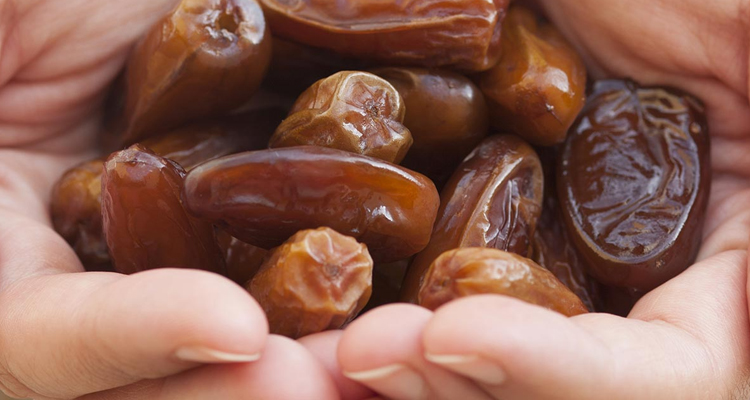
The fruit of the date palm tree is small and sweet, and 100 g carries close to 280 calories. Most of the weight of a Deglet Noor or Medjool date is sugar, about a fifth is water, and there is a fair amount of fiber and potassium in the rest. Here are the calories and benefits of dates for two common varieties, taken from USDA FoodData Central.
Calories in Deglet Noor dates
Deglet Noor is the golden, semi-dry date from Tunisia and Algeria. USDA FoodData Central (entry 171726, “Dates, deglet noor”) weighs one pitted date at 7.1 g, so a 100 g serving, roughly 3.5 ounces, is about 14 dates. That 100 g gives:
- 282 calories
- 2.45 grams of protein
- 0.39 grams of fat
- 75 grams of carbohydrates
- 63.4 grams of total sugars, mostly sucrose (23.8 g), glucose (19.9 g) and fructose (19.6 g)
- 8 grams of dietary fiber
- 656 milligrams of potassium
Water makes up 20.5 g of the 100 g. Worked out per piece, one Deglet Noor comes to about 20 calories and just over half a gram of fiber.
Calories in Medjool dates
Medjool is the large, very soft date with a rich caramel taste, a variety that originated in Morocco. USDA (entry 168191, “Dates, medjool”) weighs one pitted Medjool at 24 g, so 100 g is about four dates. Per 100 g:
- 277 calories
- 1.81 grams of protein
- 0.15 grams of fat
- 75 grams of carbohydrates
- 66.5 grams of total sugars, nearly all glucose (33.7 g) and fructose (32.0 g), with only 0.53 g of sucrose
- 6.7 grams of dietary fiber
- 696 milligrams of potassium
Water is 21.3 g per 100 g. One Medjool works out to roughly 66 calories and 1.6 g of fiber.
Reading the two sets of numbers
Gram for gram the two varieties are close: 282 against 277 calories, and 75 g of carbohydrate in both. The difference is in the piece size. A Medjool weighs more than three times as much as a Deglet Noor, so one Medjool carries about three times the calories of one Deglet Noor. If you count dates rather than weigh them, that matters.
The sugar mix differs too. A little over a third of the sugar in Deglet Noor is sucrose, while Medjool’s is almost entirely glucose and fructose.
Fiber is where Deglet Noor edges ahead on a per-100 g basis, 8 g against 6.7 g. Medjool has slightly more potassium, 696 mg against 656 mg.
Soft and dry dates
The figures above apply only to these two USDA entries. Other varieties, and the same variety at a different ripeness, can read differently, so check the label on the pack. Date sellers use “rutab” (or “rotab”) for the soft, fresh-ripe stage and “tamr” for the fully ripe, drier stage. Mazafati from Bam in Iran is a very soft, high-moisture date that needs refrigeration, and it is cold-stored so it can be sold year-round. For these two varieties, the calories and benefits of dates come down to the same few numbers: plenty of sugar, some fiber and a good amount of potassium.
A handful of dates satisfies a sweet tooth and adds some fiber and potassium to the day. At about 20 calories for a Deglet Noor and 66 for a Medjool, they are also easy to keep count of.
This article describes nutrient content only. It is not medical or dietary advice.